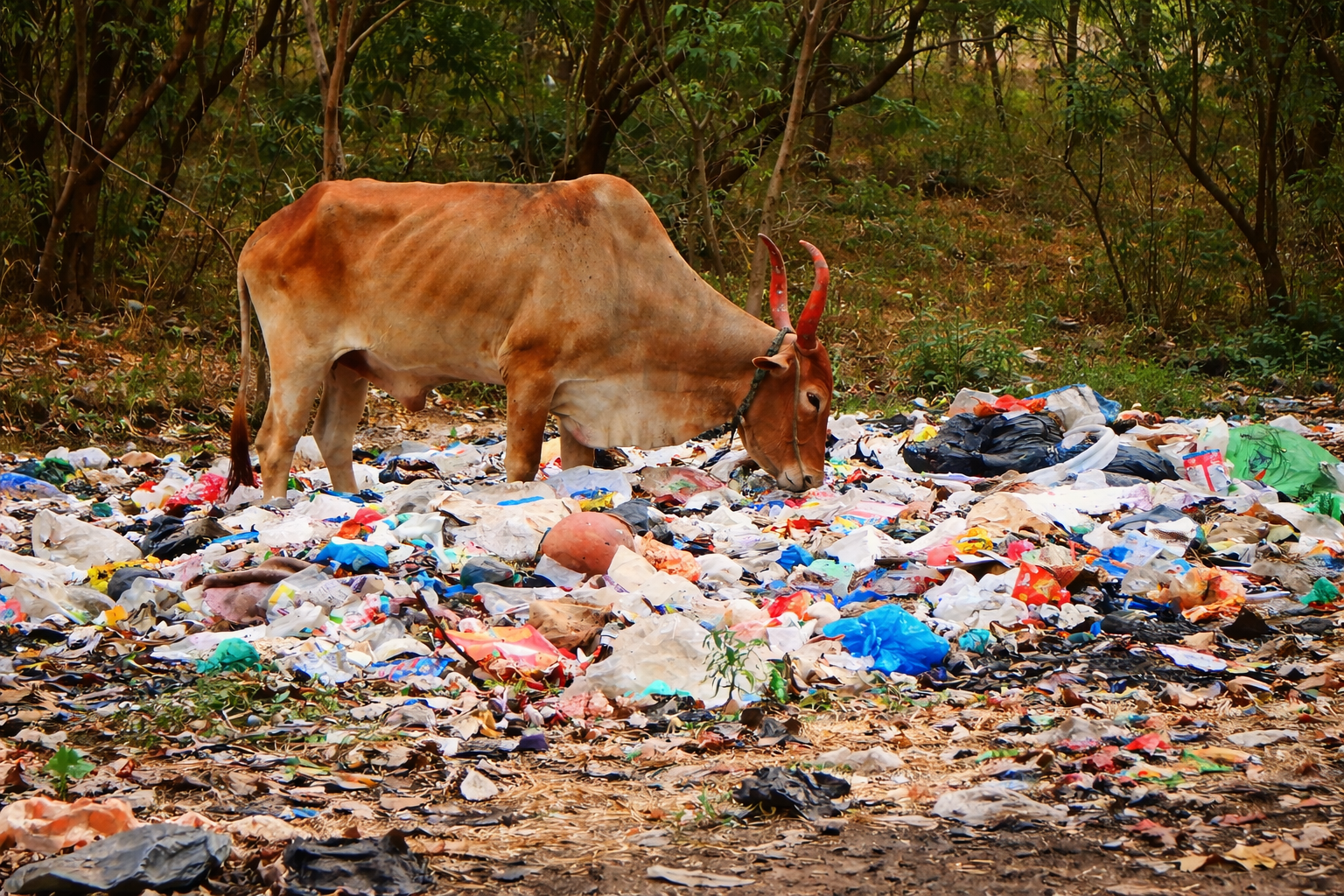
Across India’s peri-urban edges, cattle walk the same corridors as leaking waste. Thin ribs and painted horns tell a story that policy papers soften: unmanaged plastic is not inert. Animals eat it. Communities live with the aftermath.
The challenge
Single-use bags, wrappers, and film settle in scrubland and open plots because collection is irregular, incomplete, or never scheduled. Once on the ground, plastic does not announce itself as poison. To a hungry animal, it looks like something to chew.
Veterinarians and cattle shelters have documented plastic-filled stomachs for years. The public debate often stops at awareness. The operational question is harder: how do you keep the bag from ever reaching the field?
You cannot rescue every animal from plastic. You can redesign the path plastic takes before it reaches them.
The approach
gnufox treats leakage as a logistics and recovery problem. Wasty™ apps give households and partners predictable pickup windows. Facility-scale Smart Sortation™ captures film and rigid plastics that would otherwise fall through informal disposal.
When material is identified, sorted, and sold into industrial streams, it stops competing with grazing land. The cow in the photograph is the cost of doing nothing at the curb.
What changes
Fewer bags in open dumps. Fewer animals treated as unintentional waste processors. Municipalities that measure diversion—not only tonnage hauled—begin to shrink the geography of informal tips.
From Odisha outward, gnufox’s case is simple: dignity for animals and people starts with a waste system that does not abandon plastic to the roadside.