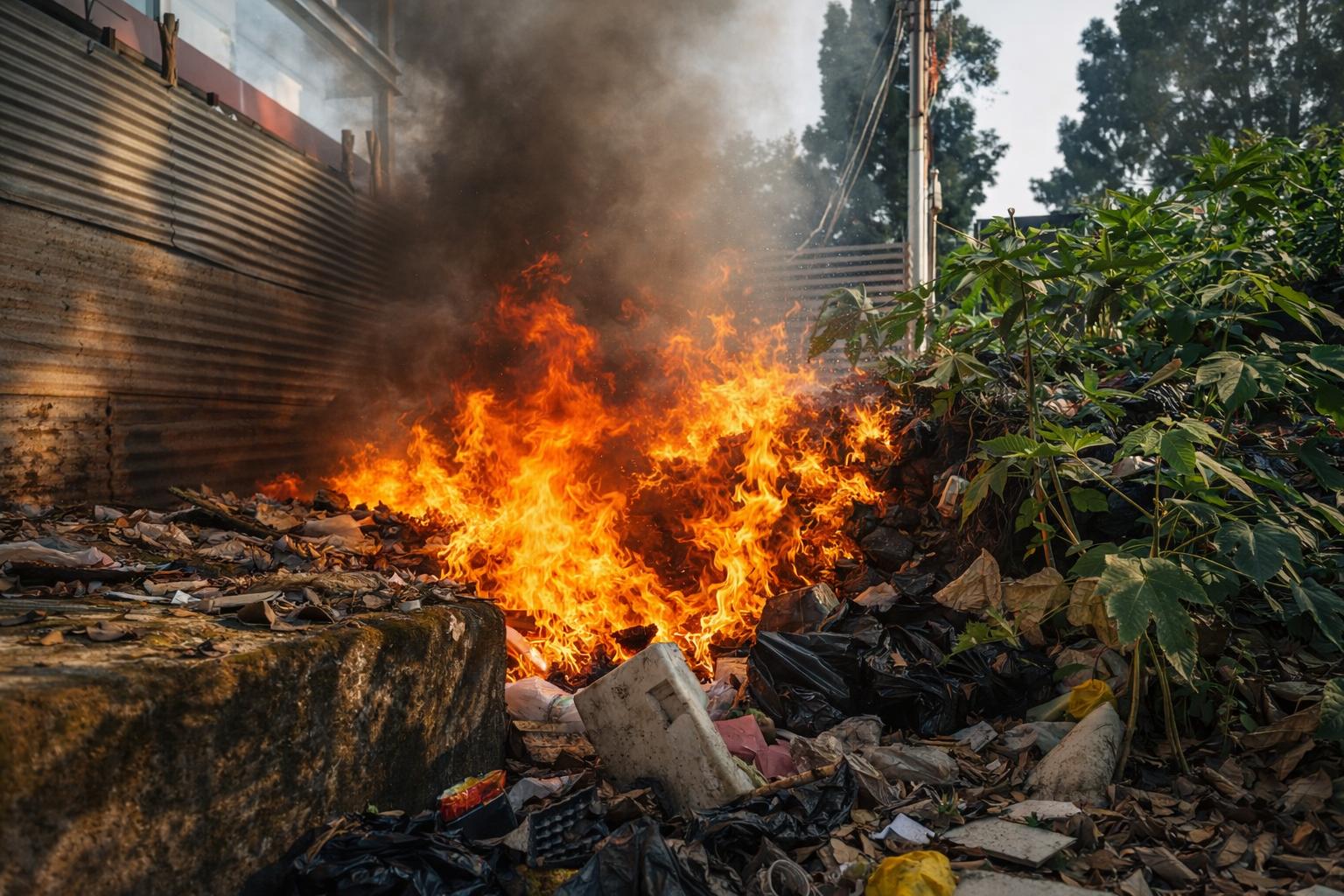
Open burning is rarely framed as infrastructure policy. It appears as a local habit, a corner fire, a plume against a metal wall. In reality it is what happens when the cost of proper disposal exceeds the cost of a match.
The challenge
Mixed piles accumulate where routes skip, bins overflow, or informal dumps become routine. Burning reduces volume quickly. It also releases black carbon, dioxins from chlorinated plastics, and fine particles into neighborhoods that already negotiate dust and traffic fumes.
Enforcement alone rarely sticks. People burn because the alternative—waiting for an unreliable pickup—feels worse. The system problem is reliability and recovery capacity, not moral failure at the street edge.
Every scheduled collection that actually arrives is a fire that never starts.
The approach
gnufox closes the gap between household waste and industrial recovery. Wasty™ gives partners and residents a clear pickup rhythm. Smart Sortation™ facilities pull high-value and hazardous-to-burn materials into controlled streams before they can be set alight.
When film, foam, and packaging have a buyer-ready path, volume sitting in alley piles shrinks. Burning stops being the cheapest way to make space.
What changes
Local air quality improves where open fires decline. Municipalities gain a diversion story they can measure. Operators see more feedstock instead of ash. The photograph of flames next to corrugated steel becomes an archive of the old default—not the daily norm.
From Bhubaneswar, gnufox builds the machinery and the apps that make that shift operational, not aspirational.